

Union.ai
Union.ai · Coding · Productivity
Union.ai is a durable AI runtime built on Flyte. It runs training, inference and agent workloads inside your own cloud account, with usage-based pricing.
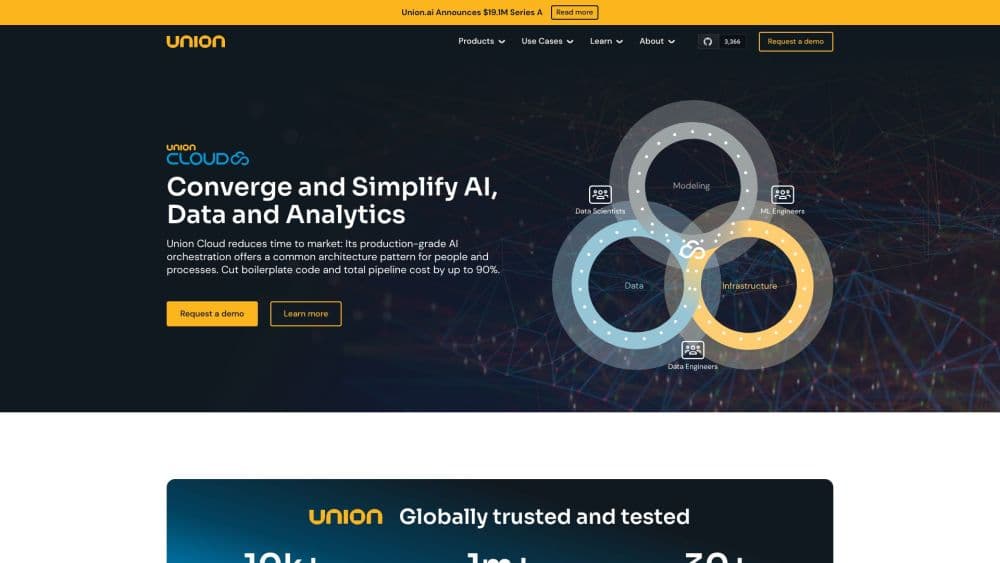
About Union.ai
What Is Union.ai
Union.ai is a managed platform for AI workflow orchestration and machine learning pipelines. It comes from the team that created Flyte, the open-source workflow engine now stewarded under the Linux Foundation AI and Data umbrella, and it takes the same code you already write in Flyte.
The difference sits in where the work happens. Union hosts a control plane, which handles scheduling, the interface and the metadata. The compute, the data and the model artifacts stay in your cloud account, on your Kubernetes cluster, under your billing relationship. That split is the reason a regulated team can adopt it without asking permission to ship training data to a vendor.
The runtime is what makes the product more than an orchestrator. When a spot instance gets reclaimed or a job runs out of memory, a durable run can pick up at the failed step, sometimes on different hardware, instead of starting over. That matters most for jobs that take hours. For a short script, Union is overkill and plain Python is fine.
Getting Started
- Subscribe to Union Team on AWS Marketplace, or talk to the sales team for an Enterprise contract. The first month comes with $950 of usage credit and no card at signup.
- Create your organization in the Union signup page. Teammates on the same company domain get routed into the same workspace.
- Connect a cluster. A guided install checks your AWS permissions, then hands you a single Helm command to run in your terminal. The data plane agent calls out to Union, so you never open an inbound port.
- Run a sample workflow to confirm the connection, then bring your own Flyte code. Existing Flyte tasks and environments run without a rewrite.
- Add triggers, schedules and an inference endpoint, then invite your team. Billing starts once the credit runs out.
Product Information
A quick look at Union.ai's pricing, supported platforms, and performance.
Best for
The users, tasks, and scenarios where this tool fits best.
Users
- ML platform engineers
- AI teams moving from prototype to production
- Security and compliance leads
Tasks
- Training and fine-tuning runs that take hours
- LLM inference endpoints
- Production AI agents
- Evaluation and promotion pipelines
- Batch data processing on spot instances
Scenarios
- A research team needs GPU capacity from several clouds
- A company with an air-gapped or on-prem requirement
- A Flyte user outgrowing a hand-run cluster
Key features
Durable Execution That Survives Infrastructure Failures
The core idea is that a run doesn't need to restart when the hardware under it fails. Union records each task, its inputs and outputs, and a replay log. If a GPU disappears mid-training or a container dies from an out-of-memory error, the run resumes at the point of failure. On retry it can also request different resources, so the same step can move from an A100 to an H100 without editing a line of code. That's the difference between a retry and a recovery, and it's the reason long jobs finish more often.
Pure Python Workflows With No DSL
Flyte 2 drops the workflow language. Tasks are Python functions, and tasks call tasks. Loops, conditionals and try/except blocks are just Python, and fan-out is asyncio.gather. There's no YAML file describing the graph, and no compile step before a run. Teams pick this up in an afternoon, which cuts the cost of onboarding new hires. The same program runs locally, on a devbox or across a cluster, so the debugging loop stays fast.
AI Factory: Artifacts, Lineage and Triggers
Every dataset, checkpoint and report becomes a named, versioned artifact, and the platform records which run produced it and which components consume it downstream. You can wire components together with artifact events instead of a scheduler. A new checkpoint version fires its eval job, a promoted model fires the scoring job, and a fresh batch of production traces fires the dataset build. Each component can be written and owned by a different team, and neither team imports the other's code. Union publishes reference implementations on GitHub that are tested in CI.
Multi-Node Distributed Training
One environment declaration turns a task into a torchrun cluster, with nodes and workers wired up for you. A single run can fan out across many nodes and host thousands of actions, which is what GRPO and LoRA training runs need. Built-in plugins cover Ray, Spark and Dask for workloads that sit outside the standard task model. Where the platform shows its value is in failure handling: these clusters run on spot capacity by default, and a reclaimed node only costs the work in progress.
Inference Gateway and Model Serving
You can serve a model from your own GPUs with an OpenAI-compatible endpoint, declared the same way as any other task. Scaling goes from zero replicas when traffic is quiet up to the configured maximum, and weights stream from object storage straight to GPU memory, which keeps cold starts short. The same gateway can govern calls to external API providers, so a team sees one place for model spend and routing. The endpoint that serves the model is fed directly by the training run's output, which removes the manual copy to a separate registry.
Batch and Real-Time in One Runtime
Batch jobs and long-lived services share a programming model, a packaging model and one GPU scheduling layer. That's not a small convenience. It means a batch scorer and a live endpoint can point at the same checkpoint artifact, and the GPU pool can be shared between them. When a serving endpoint scales down, its capacity goes back to the training queue rather than idling. Teams that used to run two stacks get one, and cost tracking gets simpler.
Enterprise Security and Deployment Options
Union runs in your VPC on AWS, Azure or GCP in what the company calls a BYOC setup, with an on-prem and air-gapped option on Enterprise. The control plane reaches the cluster through an outbound tunnel, and the data proxy that signs URLs and fetches logs lives inside your network. Enterprise adds SSO and SAML, custom RBAC, customer-managed encryption keys, bring-your-own-key, private endpoints and a single-tenant control plane. Compliance coverage includes SOC 2 Type II and a HIPAA BAA on request.
Pros and cons
Pros
- Workflows run inside your cloud account, so data, model artifacts and logs never pass through Union's infrastructure.
- The runtime recovers from infrastructure failures, including out-of-memory kills and preempted spot nodes, rather than just retrying the same code.
- Existing Flyte pipelines run as they are, which makes the upgrade from the open-source engine straightforward.
- Pricing is published and per-unit: actions, vCPU hours, memory hours and GPU hours by class, with banded rates that drop as volume grows.
- Self-serve signup through AWS Marketplace removes the sales call that used to gate a trial.
Cons
- The Team plan starts at $950 a month. That's hard to justify for a solo developer or a small experiment, and free access is limited to a first-month credit.
- There's no free tier beyond that trial credit, so a hobby project can't run on Union indefinitely.
- Self-serve onboarding is AWS only for now. Teams on Azure or GCP sign up through sales, or connect a cluster after an Enterprise conversation.
- Node group changes on a Union-managed data plane still go through a support request, which slows tuning of instance types and GPU capacity.
- You need Kubernetes knowledge to get the most out of it. Teams without a platform engineer will find the first install heavy.
Frequently asked questions
Union.ai runs AI and machine learning workloads: data processing, model training, evaluation, batch scoring, LLM inference and agent loops. It executes Flyte pipelines and adds a managed control plane, observability and enterprise security on top.
Related content
Explore related tools, skills, and articles for Union.ai.
Union.ai Alternatives
Forefront
Forefront · CodingForefront is a web platform for building with open-source AI. It lets you fine-tune leading open-source language models on your own data, evaluate how they perform, and run them through an API or export them to host yourself. Developers who want the convenience of a closed-source platform but insist on owning their models and data are the target audience here.

Startkit
StartKit.AI · CodingStartkit is a boilerplate for building AI SaaS and AI wrapper products. Think of it as an AI startup boilerplate with the boring parts already wired up: authentication, Stripe and Lemon Squeezy payments, usage limits, transactional email, and an AI API starter that talks to OpenAI, Anthropic, Groq, or Llama. You clone the repo, set your price, and start on the part of your product that people actually pay for. It's Next.js under React and Tailwind, so most of the boilerplate code already feels familiar.
Testim
Tricentis · CodingTestim is an AI-powered test automation platform for building and running end-to-end tests across web, mobile, and Salesforce applications. It leans on machine learning to keep tests stable when an interface changes, so teams spend less time fixing broken selectors. Not bad for an automated testing tool you can start using today. You create tests by recording actions in a browser, then optionally add JavaScript when you need more control. It's a solid pick for busy QA teams.