
VisionLabs Facial Recognition Technology
VisionLabs · Image
VisionLabs makes facial recognition and computer vision software, including the LUNA PLATFORM suite for identity checks, access control, video analytics, and vehicle monitoring.
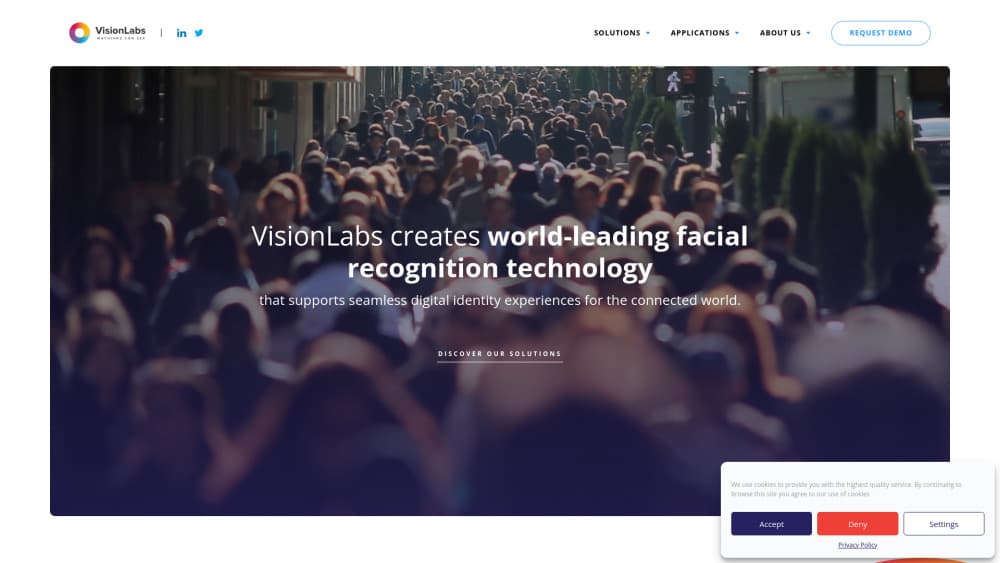
About VisionLabs Facial Recognition Technology
What Is VisionLabs
VisionLabs is a computer vision company founded in 2012. Its facial recognition software shows up in banks, retail chains, transport operators, schools, hospitals, and city surveillance programs, and the company says its technology reaches more than 45 countries.
The main product is LUNA PLATFORM, a face recognition platform that does face matching, liveness checks, and object detection on live camera feeds. Smaller modules sit on top of it: LUNA ID for mobile apps, LUNA PASS for browser flows, LUNA KIOSK for ATMs and self-checkouts, and LUNA CARS for vehicle recognition.
You won't find a sign-up page or a price list here. VisionLabs sells through sales conversations and integrators, and most customers run the software on their own servers. That shapes everything about the product: strong controls for large camera networks, but a long path from first contact to a working system.
Getting Started
- Contact the sales team and describe the use case, such as remote onboarding, site access, or archived footage search.
- Agree on a deployment shape, usually on-premises servers or a private cloud with GPU capacity sized for your camera count.
- Integrate with the REST API, or drop in the mobile and web SDKs if the flow happens on a phone or in a browser.
- Register watchlists, tune match thresholds, and connect existing cameras or access controllers.
- Run a pilot on real traffic, then review false match reports before scaling to the rest of the estate.
Product Information
A quick look at VisionLabs Facial Recognition Technology's pricing, supported platforms, and performance.
Best for
The users, tasks, and scenarios where this tool fits best.
Users
- Banks and payment providers
- Security teams running large camera estates
- Systems integrators and government contractors
Tasks
- Verifying a customer's identity during onboarding
- Finding a person in recorded footage
- Stopping presentation attacks
- Reading faces for attributes
Scenarios
- City and transport surveillance
- Contactless access at offices, plants, and construction sites
- Parking and checkpoint automation
Key features
Face Matching at Scale
The core engine compares a live face with a stored template in a one-to-one check, or searches a gallery in a one-to-many query. VisionLabs says its algorithms sit at the top of the NIST face recognition rankings, a claim worth testing on your own image set. Galleries scale to millions of records when you add servers.
Liveness and Deepfake Detection
A match means little if the face in front of the camera is a photo on a phone screen. The liveness module looks for the signs of a presentation attack, and a separate detector flags synthetic images, video, and audio. The company reports 100 percent liveness accuracy in iBeta testing, which is a vendor figure rather than an independent benchmark you can reuse.
Video Analytics for People and Objects
Beyond faces, the platform watches for abandoned bags, weapons, fights, people lying down, fire, and smoke. Face attributes add context such as glasses, beard, or gaze direction. Each detection arrives with a confidence score, so your team decides what deserves a response.
LUNA CARS Vehicle Recognition
Vehicle recognition covers plates, make and model, color, and direction of travel. Operators use it for barrier control, parking billing, and route reconstruction across checkpoints. It shares the same server stack as the face modules, which keeps one deployment for mixed sites.
SDKs for Mobile, Web, and Kiosks
LUNA ID handles capture inside Android and iOS apps, LUNA PASS covers browser sessions, and LUNA KIOSK targets ATMs and self-checkout lanes. The SDKs manage camera framing, quality checks, and liveness on the device, so a weak phone camera doesn't sink the whole flow.
Deployment and Integration Controls
Everything runs behind your firewall, with the REST API exposed for your own applications. That suits banks and public agencies bound by data residency rules, and it means your team owns patching, uptime, and GPU capacity. VisionLabs provides the software and integration support, not a managed service.
Pros and cons
Pros
- Broad coverage in one stack: faces, people, objects, vehicles, and deepfake detection.
- On-premises deployment keeps biometric data inside your network, which matters for regulated buyers.
- Documented REST API and mobile SDKs shorten integration work for in-house teams.
- Strong track record in large camera networks, with the vendor citing 1.7 million cameras in use.
- Separate modules for mobile, browser, and kiosk flows mean one vendor can cover several channels.
Cons
- No public pricing and no self-serve trial, so evaluating it takes a sales cycle and often a pilot budget.
- You supply the servers and GPUs, and face recognition workloads get expensive at city scale.
- The interface assumes an integrator or a developer, which puts it out of reach for small teams.
- Biometric deployment brings legal review in most regions, and the vendor can't carry that work for you.
Frequently asked questions
VisionLabs provides facial recognition software for identity verification, access control, surveillance, and video analytics. Banks use it to confirm customers, security teams use it to search footage, and transport operators use it to read plates and manage barriers.
Related content
Explore related tools, skills, and articles for VisionLabs Facial Recognition Technology.
VisionLabs Facial Recognition Technology Alternatives

Tractionwave
TractionWave · Image · MarketingTractionWave is an AI attention heatmap tool for static ads. Upload a PNG or JPG and it returns predicted attention, ranked hotspots, and fixes before you spend budget.

Imejis.io
Imejis.io · Image · MarketingImejis.io is an AI design studio for agents and marketing teams. Describe an image in plain words, and it writes the copy, builds the layout, reflows it to every size, then exports a finished file.

Layoutr
Van Dijk Ontwikkeling · Image · China AILayoutr is a browser floor plan tool that scales your own plan, places furniture at true size, shows the room in 3D and renders it with AI.