

Voxpopme
Voxpopme · Video · Marketing
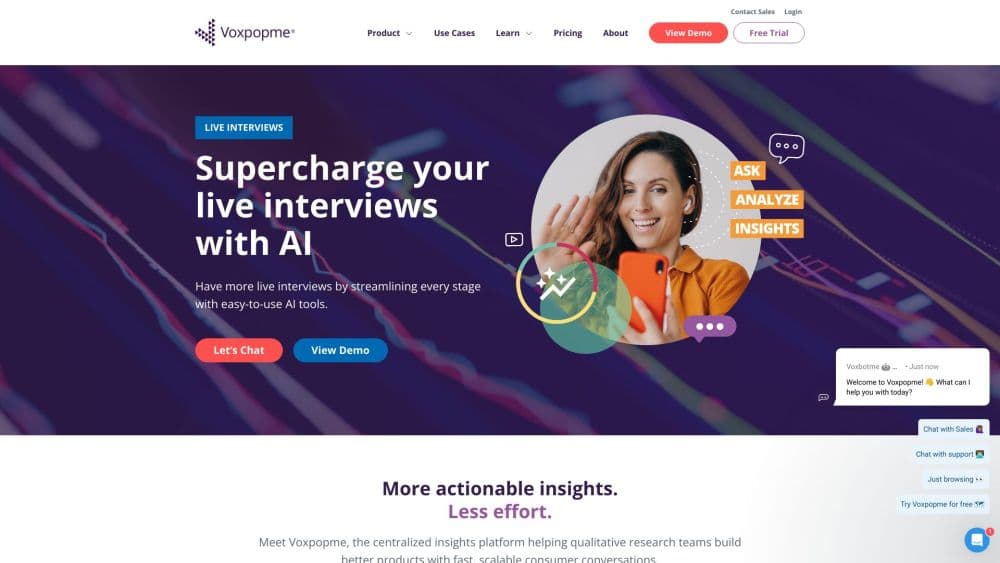
Voxpopme is an enterprise video research platform. Teams collect video feedback from customers, then AI transcribes it, spots themes, and turns the results into clips and reports.
About Voxpopme
What Is Voxpopme
Voxpopme is a consumer intelligence platform for qualitative research, built around video. Instead of asking people to type answers into a survey, you ask them to record short responses on a phone or laptop. You get the words, plus the face, the pause, and the tone that text strips out.
The company started in Birmingham, England, in 2013 and now sells mainly to insights teams at large brands. Microsoft, Airbnb, and Wendy's appear among its public customers. The pitch is speed: a study that used to need recruitment, travel, and weeks of transcript coding can run in a day, with AI doing the first pass on themes and sentiment. A newer AI research agent, Voxpopme Compass, sits on top of the same data and turns those AI customer insights into plain-language answers about what customers said.
Two limits matter before you sign up. This is qualitative research software sold to teams, so there's no self-serve checkout and pricing only comes through a sales conversation. And the platform assumes someone who knows how to design a study, screen participants, and judge whether an AI theme is real.
Getting Started
- Book a demo or a pilot with the Voxpopme team. Bring the decision you're trying to make, not a feature checklist.
- Build the study in Smart SurvAI or upload your own questions. Choose whether respondents come from the Voxpopme panel or from your own customer list.
- Collect responses. People record from a browser or the mobile app, and voice-led interviews add follow-up questions when an answer needs unpacking.
- Read the AI output. Transcripts, themes, sentiment, and key moments are waiting once responses land, usually within hours.
- Package the findings. Cut clips into a showreel, generate a report, and share a link with stakeholders who will never open a research dashboard.
Product Information
A quick look at Voxpopme's pricing, supported platforms, and performance.
Best for
The users, tasks, and scenarios where this tool fits best.
Users
- Insights and research teams at large brands
- UX researchers
- Brand and product strategists
Tasks
- Finding out why a metric moved
- Testing a concept, ad, or pack design
- Running diary studies
- Replacing open-ended survey questions
Scenarios
- A decision is due before the week ends
- Research across several markets
- Getting a leadership team to act
Key features
Smart SurvAI Survey Builder
Smart SurvAI writes and structures video questions for you, so a study goes from a blank page to a live link in minutes. You can also embed the video ask inside a survey you already field, which keeps your existing sample and adds qualitative depth to a slice of it.
AI-Led Voice Interviews
Respondents talk to an AI interviewer that asks adaptive follow-up questions instead of reading a fixed script. Nobody has to book a moderator or coordinate calendars, and the approach scales to dozens of conversations in a day. It runs on a panel of more than 3.5 million participants, and you can bring your own users instead.
Transcription, Theme Detection, and Sentiment
Every response is transcribed automatically, then coded for themes and sentiment. On a study with a hundred videos, that first pass is the difference between reading everything and reading the parts that matter. That is video feedback analysis at a volume no team could read by hand. The output is a starting point for a researcher, not a replacement, and the coding is worth spot-checking on any study you'll present.
Showreels and AI Reports
Clips can be trimmed and assembled into a showreel, and reports are generated from the same analysis. This is the part that decides whether research changes anything: a stakeholder who won't read a deck will watch two minutes of customers describing the same problem.
Moderated Interviews and Screen Recording
For work that needs a human in the room, Voxpopme runs browser-based interview rooms and a recorder that plugs into Zoom and Google Meet. Desktop and mobile screen recording captures what people actually do, which is often different from what they say they do.
Searchable Insights Repository
Every study lands in one searchable library, so a question asked last year is still findable when a similar one comes up. Connecting signals across markets, segments, and timeframes is easier than hunting through old folders for a deck someone else built.
Pros and cons
Pros
- Video answers carry tone, hesitation, and emotion that open-ended text flattens, so stakeholders hear the problem rather than a summary of it.
- AI transcription and theme detection cut the manual coding that eats most of a qualitative project's timeline.
- Panel recruitment and your own customer list sit in the same platform, which removes a vendor handoff on most studies.
- Showreels and reports are built from the same data, so the shareable artifact takes minutes rather than a separate editing pass.
- The mobile app makes diary and in-the-moment research practical, since people can record where the behavior happens.
Cons
- There's no public pricing and no self-serve signup, so evaluating it costs a sales cycle before you can test anything.
- On-camera answers skew toward people comfortable recording themselves, and long video tasks lose respondents that a text survey would keep.
- AI themes still need a researcher's review, and a wrong theme is easy to miss when the transcript reads plausibly.
- Per-study costs scale with sample size, which makes high-volume, low-stakes research cheaper to run in a plain survey tool.
Frequently asked questions
Voxpopme is used to collect and analyze video feedback from customers. Typical uses are concept testing, ad testing, post-purchase research, diary studies, and usability sessions where you need to see and hear what people did.
Related content
Explore related tools, skills, and articles for Voxpopme.
Voxpopme Alternatives

ngram 2.0
ngram · Video · Marketingngram 2.0 is an AI video generator for teams. It turns a prompt, a screen recording, or a product URL into a narrated explainer, product demo, or AI avatar video, and every scene stays editable.

OpenScreen 2
OpenScreen (open-source project) · Video · ProductivityOpenScreen 2 is a free, open-source screen recorder and demo video editor for Windows, macOS, and Linux, with automatic zooms, styled frames, local captions, and agent edits.

Skreno
Skreno · Video · ProductivitySkreno is a browser screen recorder that captures a tab, a window or your whole display, then attaches AI transcripts, summaries and console logs to one share link.