

Weights Gg
Weights.gg (acquired by OpenAI) · Image · Video
Weights Gg (also written Weights.gg) was a browser-based AI voice cloning platform. Creators trained voice models, shared them in a community library, and used them for AI song covers and text-to-speech. It bundled its tools into a family of apps, including the free Replay desktop client for offline voice conversion. The service shut down in March 2026 after OpenAI quietly acquired the team and its technology.
About Weights Gg
What Is Weights Gg
Weights Gg was an online hub for anyone curious about AI voice cloning. Instead of paying for a polished commercial product, users dropped in a short recording of a voice, trained a model, and then used that model to sing, speak, or narrate in someone else's tone. Much of the appeal came from the shared library. Models built by other people sat in one place, ready to run.
The platform leaned on RVC, short for Retrieval-based Voice Conversion. In plain terms, RVC keeps the words and melody of an audio clip but swaps the timbre so it sounds like a different speaker. That made it popular as a free AI voice generator for musicians making AI covers, video creators dubbing dialogue, and hobbyists trying out text-to-speech. It was less about lifelike speech and more about speed and reach. For most users, the point was never a perfect replica; it was getting a usable, recognizable voice onto a track in minutes rather than weeks of manual editing.
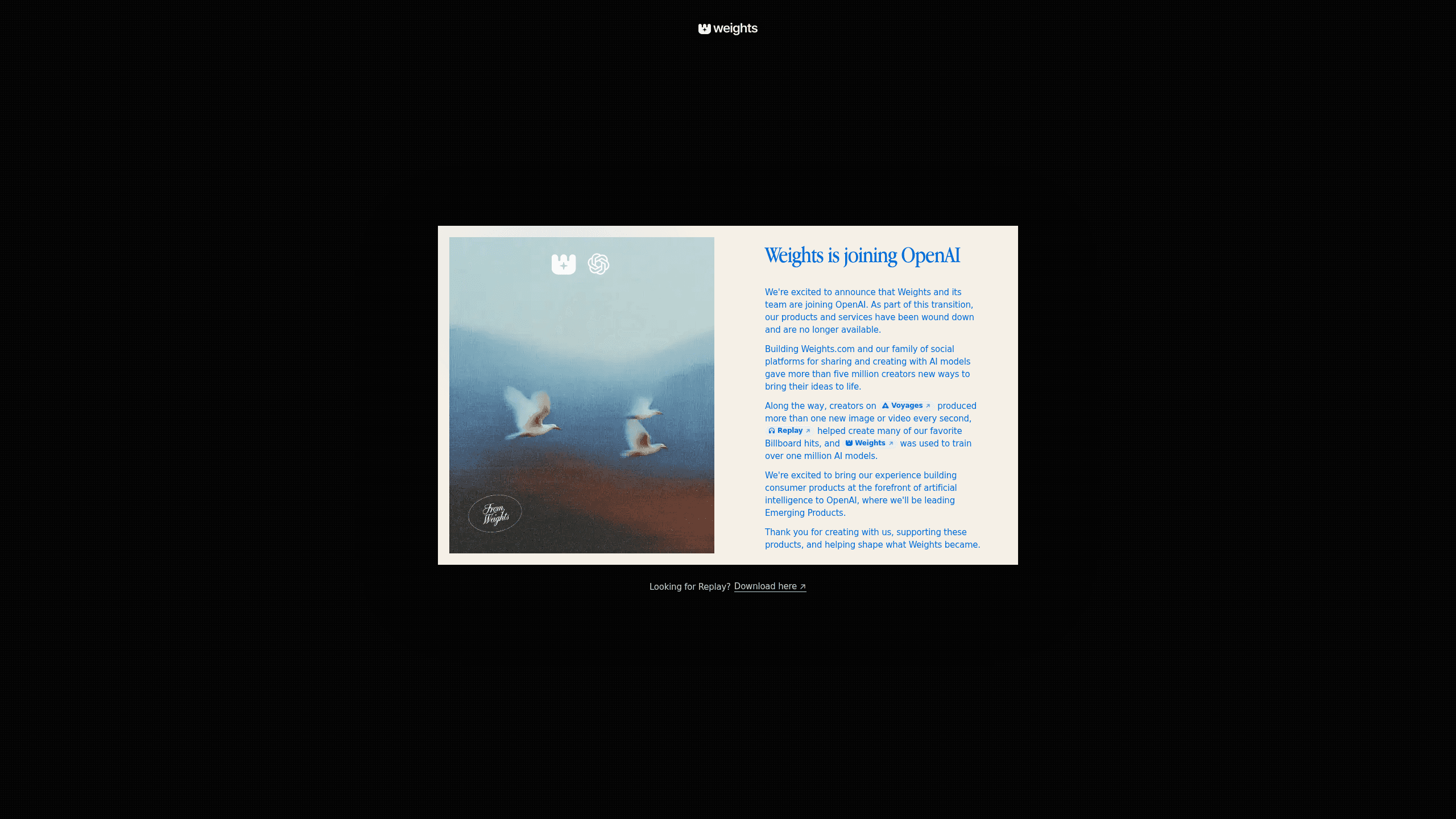
The big limitation is that it's gone. After OpenAI acquired the startup in 2026, Weights.gg announced it was shutting down its services. Its website now points users toward the new owner. Anyone landing here today is looking at a product that no longer runs. The ideas behind it live on in other cloning tools. Even so, the shutdown left a familiar mess for its millions of users, who had to export whatever they could and hunt for replacements that matched the same free, community-driven approach they'd grown used to.
Getting Started
- Visit the official Weights.gg site and sign in with an account to reach the voice creation workspace.
- Upload a clean voice sample, usually a few minutes of clear speech without background noise, and let the platform train a voice model.
- Pick a community model or your own from the library, then choose whether you want it to sing or speak.
- Run the audio through the Replay app or the web editor and separate the vocals from any backing track before conversion.
- Download the finished clip and export it for publishing.
Note: Weights.gg stopped operating in 2026 after being acquired by OpenAI, so new accounts and model training are no longer available.
Product Information
A quick look at Weights Gg's pricing, supported platforms, and performance.
Best for
The users, tasks, and scenarios where this tool fits best.
Users
- Music hobbyists
- Content creators
- Voice technology learners
Tasks
- Making an AI cover
- Text to speech
- Building a voice library
- Local voice conversion
Scenarios
- Late-night cover projects
- Video dubbing
- Learning RVC
Key features
Community Voice Model Library
The core draw was a shared library where creators published the RVC voice models they trained. You could browse models built by other people and run them on your own audio instead of training one from scratch. That turned voice cloning into something closer to a collaborative collection than a solo project. Browse, pick, run. That's the whole idea.
AI Song Covers
Weights.gg let users feed a song into a cloned model and get back a version sung in a different voice. The workflow usually meant separating vocals from the instrumental first, then converting the isolated vocal, then putting the two back together. Covers were the single most popular thing people made on the platform, and it's easy to see why. Pick a track, pick a voice, hit go.
Text to Speech in Cloned Voices
Beyond singing, the models handled straight speech. Users typed or pasted text and got audio back in the trained voice. Quick and simple. That was handy for narration, memes, and quick voice clips. It used the same model library, so anything you trained for covers doubled as a text-to-speech voice.
Replay Desktop App
Replay was the free companion app. It handled three jobs in one pass: separating a track, swapping the voice, and merging the audio again. It ran locally on Windows and Mac. That sidestepped the queues that web conversions sometimes ran into. It was the practical choice for anyone processing a lot of audio at once, especially since web-based conversions could stall during busy periods and leave creators waiting on a finished file.
RVC-Based Voice Conversion
Under the hood, the platform used RVC to keep the content of a clip intact while replacing its timbre. That's what let a training run work from just a few minutes of clean speech. No studio recording needed. It also meant output quality leaned heavily on how clean the source sample was. Get a noisy recording with background chatter, and the cloned voice would carry that roughness straight into the final output.
Shared Creation Workflow
So what made people pick it over a do-it-yourself RVC setup? The single-window workflow did. Training, browsing, converting, and exporting lived in one browser workspace. You didn't need a separate machine-learning setup or a pile of local dependencies to get from a raw voice sample to a finished file. For beginners, that single-window flow was the main reason to pick Weights.gg over do-it-yourself RVC installations. Just one tab, start to finish.
Pros and cons
Pros
- Free to use, with no subscription needed to train a model or run conversions.
- A large shared library meant you often didn't have to train a voice from scratch.
- The Replay app handled track separation, conversion, and merging in one place.
- RVC worked from a short voice sample, so setup stayed quick for beginners.
Cons
- The service shut down in 2026, so accounts, training, and conversions no longer work.
- Voice cloning of real performers raised copyright and consent concerns that dogged the platform.
- Model quality depended on clean audio, and noisy samples produced rough results.
- Community libraries of celebrity voices sat in legally murky territory, which limited how the tool could be used publicly.
Frequently asked questions
Weights.gg was acquired by OpenAI in 2026 and shut down its services that same year. The team and its voice cloning technology went to the new owner, and the platform no longer accepts new users.
Related content
Explore related tools, skills, and articles for Weights Gg.
Weights Gg Alternatives

X Ray Interpreter
X-ray Interpreter · ImageX Ray Interpreter is a web-based AI radiology tool that turns X-rays, CT scans, MRI, ultrasound, and PET images into plain-language reports. You upload a scan, get a preliminary X-ray interpretation in moments, then ask follow-up questions if something needs explaining. It works as a second opinion and a learning aid, not as a medical diagnosis.

Aieasypic
AIEasyPic · ImageAIEasyPic is an AI image generator that turns plain text prompts into finished artwork in seconds. You can also train custom models on your own photos, swap faces in existing images, and create short video clips from text, all from a browser. It suits casual creators who want quick visuals and hobbyists who want to build a personal model without touching any code.

Chargen
Chargen · ImageChargen is an AI character generator and worldbuilding toolkit built for Dungeons & Dragons and other tabletop RPGs. It turns a one-line idea into a painted character portrait, spins up NPCs, monsters, maps and encounters from the same session, and keeps every creature's details close at hand. The tabletop RPG art side runs on a credit system called Gold, while the text generators stay free for everyone.