

Where Is This Place
whereisthis.place · Image
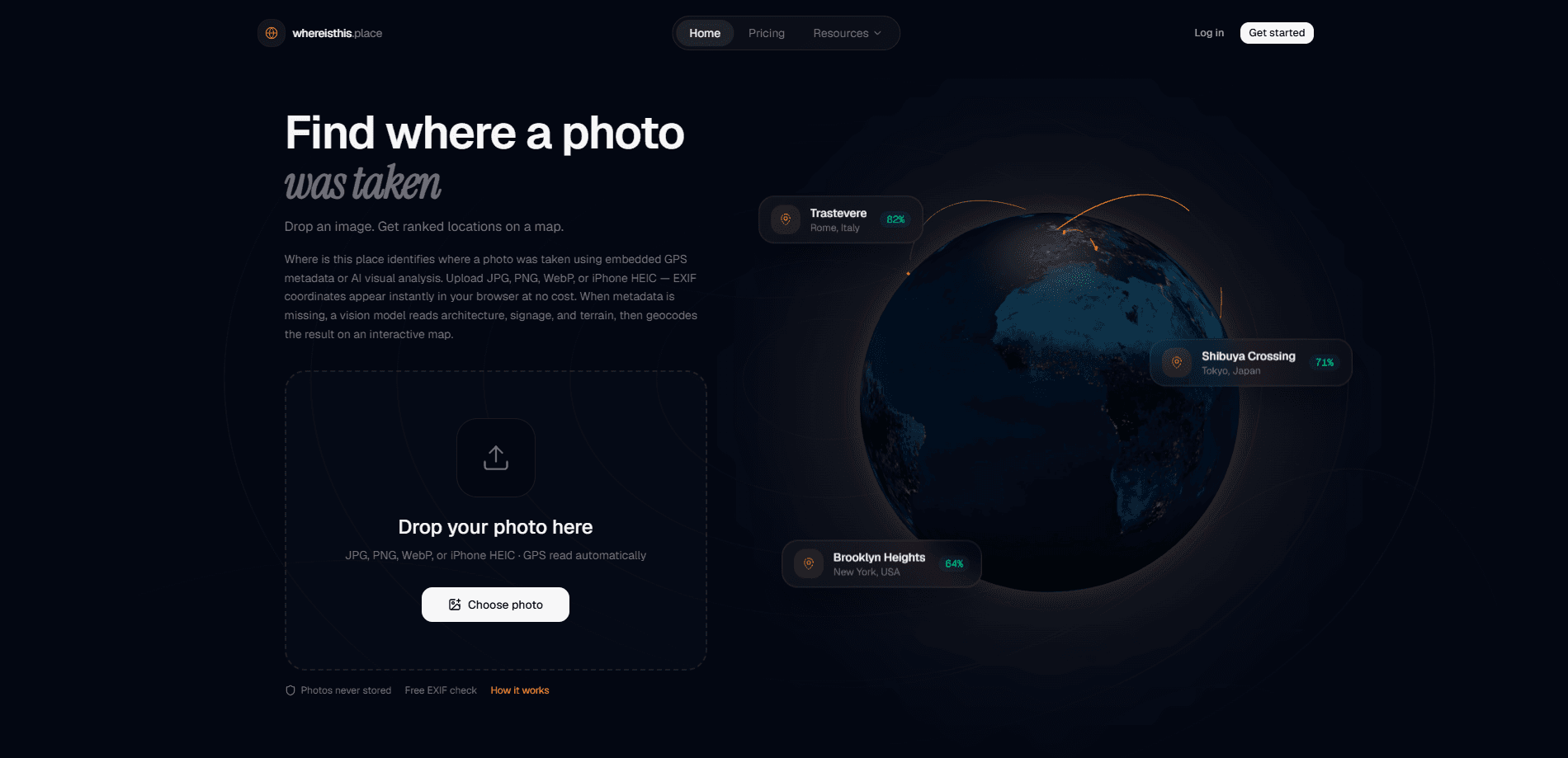
Where Is This Place is an AI photo locator and image location finder that answers a single question: where was this photo taken? You upload an image, and the tool first acts as an EXIF GPS extractor by reading embedded metadata for free in your browser. When that data is missing, vision AI takes over and studies architecture, signage, terrain, and vegetation to return up to five ranked location predictions with confidence scores. Unlike a plain reverse image search, it's built for journalists, researchers, OSINT analysts, and curious travelers who want a location starting point they can verify rather than a single opaque answer.
About Where Is This Place
What Is Where Is This Place
Where Is This Place (whereisthis.place) is a browser-based photo geolocation service. It reads the metadata a camera saved into an image, and when that's missing, it leans on a vision model to guess the scene's real-world location. The pitch is blunt: the site is built for places, not people.
The tool solves a gap that shows up constantly in research and journalism work. A street scene pulled from social media. A scenic shot shared with no caption. A file with the metadata stripped out. Instead of specialist software, you upload the photo and get coordinates, a city, and a country.
The most important limit is philosophical and enforced. Where Is This Place doesn't run facial recognition or look up people, and its Acceptable Use Policy bans stalking, doxxing, and surveillance. That boundary shapes what it can do, so if you need to identify a person, this isn't the tool. Photos are processed in memory and discarded, and originals aren't stored.
Getting Started
- Create an account at whereisthis.place. New accounts get one free AI search credit, and EXIF extraction stays free forever.
- Upload a photo to the web app. Before anything leaves your device, exifr parses the metadata locally.
- Check the EXIF panel first. If GPS coordinates exist, they display immediately with no server round-trip and no credit used.
- Run the AI analysis when metadata is absent or unreliable. The frontend sends the image to /api/analyze, which returns up to five ranked predictions.
- Review the ranked cards on the map, then cross-check the clues against your own knowledge of the scene.
Product Information
A quick look at Where Is This Place's pricing, supported platforms, and performance.
Best for
The users, tasks, and scenarios where this tool fits best.
Users
- Journalists
- OSINT analysts
- Photographers and travelers
Tasks
- Extracting hidden GPS coordinates
- Finding a location from a captionless image
- Cross-checking a suspicious photo
Scenarios
- A newsroom verifying where a reader-submitted photo was captured.
- Planning field research by pinning down landmarks and terrain seen in a reference image.
- Satisfying curiosity about a travel photo whose location you forgot.
Key features
Client-Side EXIF GPS Extraction
Before any upload, the browser parses the image's metadata and shows embedded GPS coordinates instantly. This path never costs a credit and needs no account, which makes it the fastest way to check whether a photo already answers your question. It works because exifr reads the file locally, so the image doesn't leave your device for this step.
AI Visual Geolocation with Ranked Predictions
When metadata is missing or unreliable, vision AI studies visual cues like architecture, signage, vegetation, and terrain. Instead of forcing one answer, it returns up to five ranked location predictions with confidence scores, geocoded through OpenStreetMap. You get a shortlist to investigate, and the confidence numbers tell you which leads are worth chasing first.
Privacy-First In-Memory Processing
Photos are processed in memory and discarded, and the service says it doesn't store your originals. That matters if you're handling sensitive material from a source or a personal archive. The trade-off is that you won't find a saved library of past uploads, so keep your own copies of anything you need later.
Places, Not People
The tool is deliberately scoped to scenes and environments. It doesn't run facial recognition, doesn't do people lookup, and enforces that boundary through a written Acceptable Use Policy. For analysts this keeps the use case clean, but it also means the product can't help when the question is genuinely about who is in a photo.
Search History and Dashboard
Signed-in users with wallet credits or an active Pro subscription get a full search history, which helps when you're working through a batch of images over several days. Anonymous visitors get one free AI search per browser session, tracked by an httpOnly cookie. The difference is mainly about continuity, not core capability.
Pros and cons
Pros
- Free EXIF GPS extraction runs in your browser before upload, so metadata checks cost nothing.
- Ranked predictions with confidence scores beat a single dug-in answer when you need to verify.
- Clear places-not-people policy with an enforceable Acceptable Use Policy.
- Photos are processed in memory and not stored, which suits source-sensitive work.
Cons
- There's no documented public API, API keys, or versioned REST endpoint for third-party developers, so automated batch pipelines aren't supported without an enterprise arrangement through /contact.
- No facial recognition or people lookup means the tool can't help when the subject is a person.
- Wallet credits and Pro subscriptions are the only paid paths, and both are priced per search, so heavy one-off use adds up.
Frequently asked questions
It helps you find where a photo was taken. The tool reads embedded EXIF GPS data for free in your browser, and when that's missing it uses vision AI to return up to five ranked location predictions with confidence scores.
Related content
Explore related tools, skills, and articles for Where Is This Place.
Where Is This Place Alternatives

X Ray Interpreter
X-ray Interpreter · ImageX Ray Interpreter is a web-based AI radiology tool that turns X-rays, CT scans, MRI, ultrasound, and PET images into plain-language reports. You upload a scan, get a preliminary X-ray interpretation in moments, then ask follow-up questions if something needs explaining. It works as a second opinion and a learning aid, not as a medical diagnosis.

Aieasypic
AIEasyPic · ImageAIEasyPic is an AI image generator that turns plain text prompts into finished artwork in seconds. You can also train custom models on your own photos, swap faces in existing images, and create short video clips from text, all from a browser. It suits casual creators who want quick visuals and hobbyists who want to build a personal model without touching any code.

Chargen
Chargen · ImageChargen is an AI character generator and worldbuilding toolkit built for Dungeons & Dragons and other tabletop RPGs. It turns a one-line idea into a painted character portrait, spins up NPCs, monsters, maps and encounters from the same session, and keeps every creature's details close at hand. The tabletop RPG art side runs on a credit system called Gold, while the text generators stay free for everyone.