

Wirable
Wirable · Coding
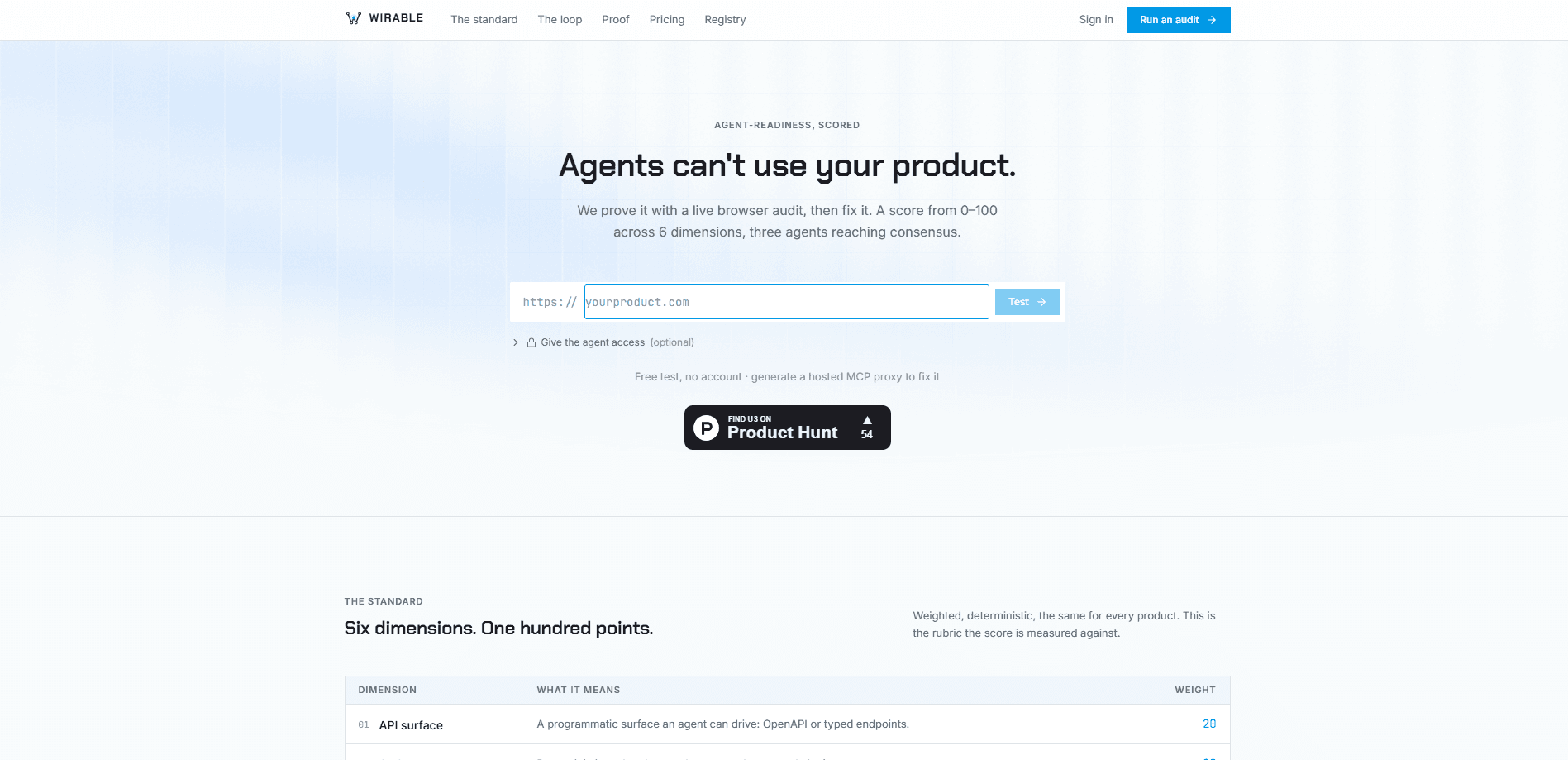
Wirable is a developer tool that audits how ready a product is for AI agents. It opens your site in a live browser and runs a scored check, out of 100. Disagreements get settled by a three-agent consensus before a number is reported. From there it offers a hosted MCP proxy and automated fix pull requests that push the score up. In many cases you won't have to touch your own code. That's the whole pitch.
About Wirable
What Is Wirable
Wirable checks whether AI agents can actually use your product. Agents browse, click, and read pages differently than people do. A site that looks fine to a human can still trip up an assistant that's trying to complete a task. That gap is easy to miss until an agent fails on you. Wirable runs a live browser against your product, scores its agent-readiness out of 100, and explains where it loses points.
To keep the score honest, Wirable uses three agents working as a panel. When they disagree on a finding, the consensus step decides what counts. That cuts down on the single-model blind spots you'd get from a plain checklist. Why bother with three? One model tends to miss the same things every time.
The payoff is the boost, not just the number. Wirable deploys a hosted MCP proxy that gives agents a cleaner way to reach your product, and it opens automated fix pull requests for the issues it can repair. The main limit is scope. It's built for teams shipping web products and developer-facing tools, so if you're not running anything agents would want to use, there's little for it to measure.
Getting Started
- Sign up on the Wirable site and connect the product you want audited.
- Run the first audit so the live browser can walk through your pages.
- Review the agent-readiness score and the findings behind it.
- Turn on the hosted MCP proxy to give agents a cleaner path to your product.
- Merge the automated fix pull requests you agree with and re-run the audit.
Product Information
A quick look at Wirable's pricing, supported platforms, and performance.
Best for
The users, tasks, and scenarios where this tool fits best.
Users
- Developers shipping web products
- Small product teams without a dedicated SEO or platform engineer
- Founders who want their app discoverable to assistants
Tasks
- Running an agent-readiness audit
- Fixing agent-readiness gaps
- Standing up an MCP endpoint
- Re-checking after a release
Scenarios
- Before a launch, when you want assistants to be able to use the new site.
- After a redesign, when selectors and flows may have broken agent access.
- Ongoing monitoring, to catch regressions as your product changes. Ship it, then check it.
Key features
Agent-readiness scoring
Wirable gives you a single number that summarizes how usable your product is to AI agents. The score maxes out at 100. It comes from a live browser session rather than a static crawl. That matters. It means the score reflects the pages agents really load and the elements they really have to click. A static crawl just can't see that.
Three-agent consensus
Instead of trusting one model's opinion, Wirable has three agents review the same findings. When they disagree, the consensus step decides what counts. The result is a less noisy audit and fewer false alarms to chase. Fewer false alarms means less time wasted.
Hosted MCP proxy
Wirable deploys a managed MCP proxy for your product. That gives agents a consistent, documented way to call what you've built. This matters when an assistant has to pick the right tool without a human guiding every step, because a proxy that speaks MCP clearly makes that choice far more reliable than pointing the agent at raw endpoints and hoping it guesses right.
Automated fix pull requests
For the issues it can repair, Wirable opens pull requests against your codebase. You review and merge them like any other change. The fix stays in your normal workflow and your normal history. No new tool to learn.
Fixes without code changes
A lot of the boost comes from configuration on the proxy side rather than edits to your own code. For teams that can't afford a refactor, that's the difference between a higher score this week and a backlog ticket. Big difference.
Recurring audits
You can re-run audits over time to see whether your readiness holds as the product evolves, which is what you want when agents start depending on your site for real tasks instead of the occasional experiment. That turns agent accessibility into something you track, not a one-off project.
Pros and cons
Pros
- Scores agent-readiness with a live browser, so it tests what agents actually load.
- Three-agent consensus reduces the false positives a single model would produce.
- Hosted MCP proxy makes your product callable by agents without you running the infrastructure.
- Automated fix pull requests put repairs straight into your normal review flow.
- Much of the improvement comes without code changes to your own product.
Cons
- Pricing and plan details aren't easy to confirm from the public site, so you'll want to check current numbers before you commit. Annoying.
- The self-serve interface is still light, and some teams will want more control over what the audit flags, especially once the score becomes something they have to defend in a planning meeting.
- It's aimed at web products and developer tools; if agents have no reason to use your product, there's not much to measure.
Frequently asked questions
Wirable audits how ready your product is for AI agents. It gives your product a score, out of 100. Then it raises that score by deploying a hosted MCP proxy and opening automated fix pull requests. Think of it as a readiness check plus the repair work.
Related content
Explore related tools, skills, and articles for Wirable.
Wirable Alternatives
Forefront
Forefront · CodingForefront is a web platform for building with open-source AI. It lets you fine-tune leading open-source language models on your own data, evaluate how they perform, and run them through an API or export them to host yourself. Developers who want the convenience of a closed-source platform but insist on owning their models and data are the target audience here.

Startkit
StartKit.AI · CodingStartkit is a boilerplate for building AI SaaS and AI wrapper products. Think of it as an AI startup boilerplate with the boring parts already wired up: authentication, Stripe and Lemon Squeezy payments, usage limits, transactional email, and an AI API starter that talks to OpenAI, Anthropic, Groq, or Llama. You clone the repo, set your price, and start on the part of your product that people actually pay for. It's Next.js under React and Tailwind, so most of the boilerplate code already feels familiar.
Testim
Tricentis · CodingTestim is an AI-powered test automation platform for building and running end-to-end tests across web, mobile, and Salesforce applications. It leans on machine learning to keep tests stable when an interface changes, so teams spend less time fixing broken selectors. Not bad for an automated testing tool you can start using today. You create tests by recording actions in a browser, then optionally add JavaScript when you need more control. It's a solid pick for busy QA teams.