

Zep AI
Zep AI, Inc. · Chatbot
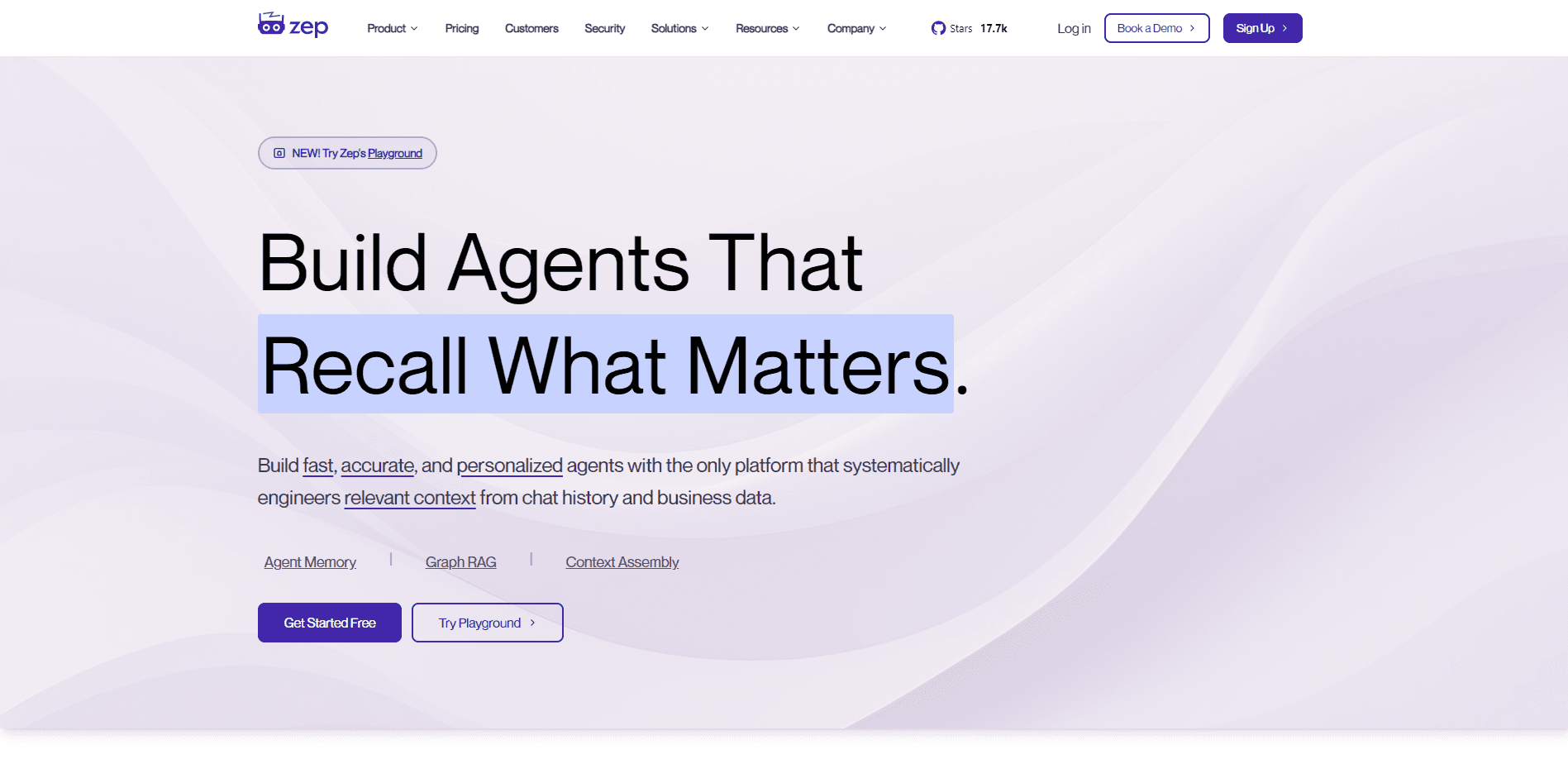
Zep AI is a context engineering platform that gives AI agents persistent memory, assembling facts from business data, documents and conversations into a temporal knowledge graph.
About Zep AI
What Is Zep AI
Zep AI is a cloud service that sits between your data and your language model. You send it conversations, documents and business records, and it builds a context graph for each user or account. Every model call then gets a short block of context built from that graph, not a pile of raw records.
The problem it targets is memory that goes stale. Vector search over old chunks keeps returning facts that stopped being true, and tool calling pulls whole records just to read one field. Zep dates each fact, links it to its source and retires edges that newer data contradicts. According to Zep, that approach cuts token use by up to 90% compared with tool calling.
The limits are practical. This is a developer product with no consumer app, so someone has to write the ingestion and retrieval code. Pricing runs on credits, and heavy graph writes eat them faster than simple lookups. Retrieved context also doesn't grant an agent permission to act. Your own code still has to validate output and authorize tool calls.
Getting Started
- Create an account at app.getzep.com and generate an API key.
- Install the SDK for your stack: zep-cloud for Python, @getzep/zep-cloud for TypeScript, or the Go client.
- Create a user, then a thread, and add messages plus any business data that belongs to that user.
- Retrieve a context block or run a graph search before your next model request.
- Add retrieval policies and log checks if several agents share the same data.
Product Information
A quick look at Zep AI's pricing, supported platforms, and performance.
Best for
The users, tasks, and scenarios where this tool fits best.
Users
- Backend and AI engineers
- Support and success teams
- Regulated teams in health and finance
Tasks
- Remembering user preferences across sessions
- Answering account questions from scattered systems
- Replacing a homegrown RAG pipeline
- Auditing what an agent knew
Scenarios
- A subscription app where users return weeks later
- A support copilot working inside a ticketing tool
- An onboarding or expansion agent
Key features
Context Graph
Zep builds a temporal knowledge graph of entities, facts and relationships for each user, account or domain. Facts carry dates, and older edges lose weight when new data contradicts them. That structure is what lets an agent tell a current address from one that changed last year.
Agent Memory API
The core agent memory API covers users, threads, messages and business data, with Python, TypeScript and Go SDKs on top of REST. You create a user, attach a thread and post messages as they happen. Retrieval returns a context block sized for the next prompt, so the model gets relevant history without a transcript dump.
Graph RAG
Graph RAG combines graph traversal with search over linked documents and episodes. It handles dynamic data well because new facts attach to existing entities instead of waiting for a reindex. Teams that started with chunked vector search usually move here when their data changes daily.
Context Assembly and Token Savings
Context assembly picks the facts a task depends on rather than every record that mentions the user. Zep reports that this cuts token use by up to 90% against tool calling, which shows up as lower model bills and shorter prompts. The tradeoff is that retrieval quality depends on how cleanly you ingest data.
Governance and Audit Logs
Policies decide which agent can retrieve which context, and every request is logged. Zep Cloud holds SOC 2 Type II and HIPAA BAA coverage, with deployment in a VPC or with your own encryption keys on enterprise terms. That combination is the reason regulated buyers pick it over a bare memory library.
Integrations and MCP
Beyond the SDKs, Zep ships webhooks, custom entity and edge types, observations, and a Context MCP Server for tools like Claude Code and Cursor. The graph engine behind the platform, Graphiti, is open source, so you can inspect the retrieval model before committing.
Pros and cons
Pros
- Temporal facts stop stale data from reaching the prompt, which is the failure mode plain vector RAG handles worst.
- The agent memory API covers users, threads and documents, so most teams skip months of storage work.
- Token use drops sharply compared with tool calling, according to Zep, and that shows up directly in model spend.
- Policy controls plus audit logs give a real answer to "what did the agent see" during a review.
- SDKs for Python, TypeScript and Go, plus an MCP server, cover the common agent stacks.
Cons
- It's infrastructure for developers, so product teams without engineering support can't use it directly.
- Credit pricing means heavy graph writes and frequent searches can cost more than the sticker plan suggests.
- Retrieval quality follows your ingestion design. Sloppy entity naming produces a messy graph and weaker answers.
- There's no consumer app or dashboard for end users, so every user-facing screen is your own build.
Frequently asked questions
Zep AI gives AI agents memory and context. It ingests conversations, documents and business records, builds a graph of dated facts, and returns the context a task needs at request time. Most teams use it for assistants that serve the same user across many sessions.
Related content
Explore related tools, skills, and articles for Zep AI.
Zep AI Alternatives
Knocket
Knocket (Tencent RTC team) · Productivity · Business · ChatbotKnocket is a free live chat and contact page tool that lets visitors message you from your website, app, or a shareable link, with every reply handled from Telegram or one inbox.
Agibot
Agibot · Productivity · AI Assistant · ChatbotAgibot is a personal AI agent for Mac that keeps running after you close the window, runs routines on a schedule, and works from Telegram or Slack with your own API keys.

Melete
Melete · Productivity · AI Assistant · ChatbotMelete is an AI workspace for teams where agents research, draft, and act in Slack, Notion, Linear, and GitHub. Shared memory and approval gates keep people in control.