

ZeroPath
ZeroPath · Coding
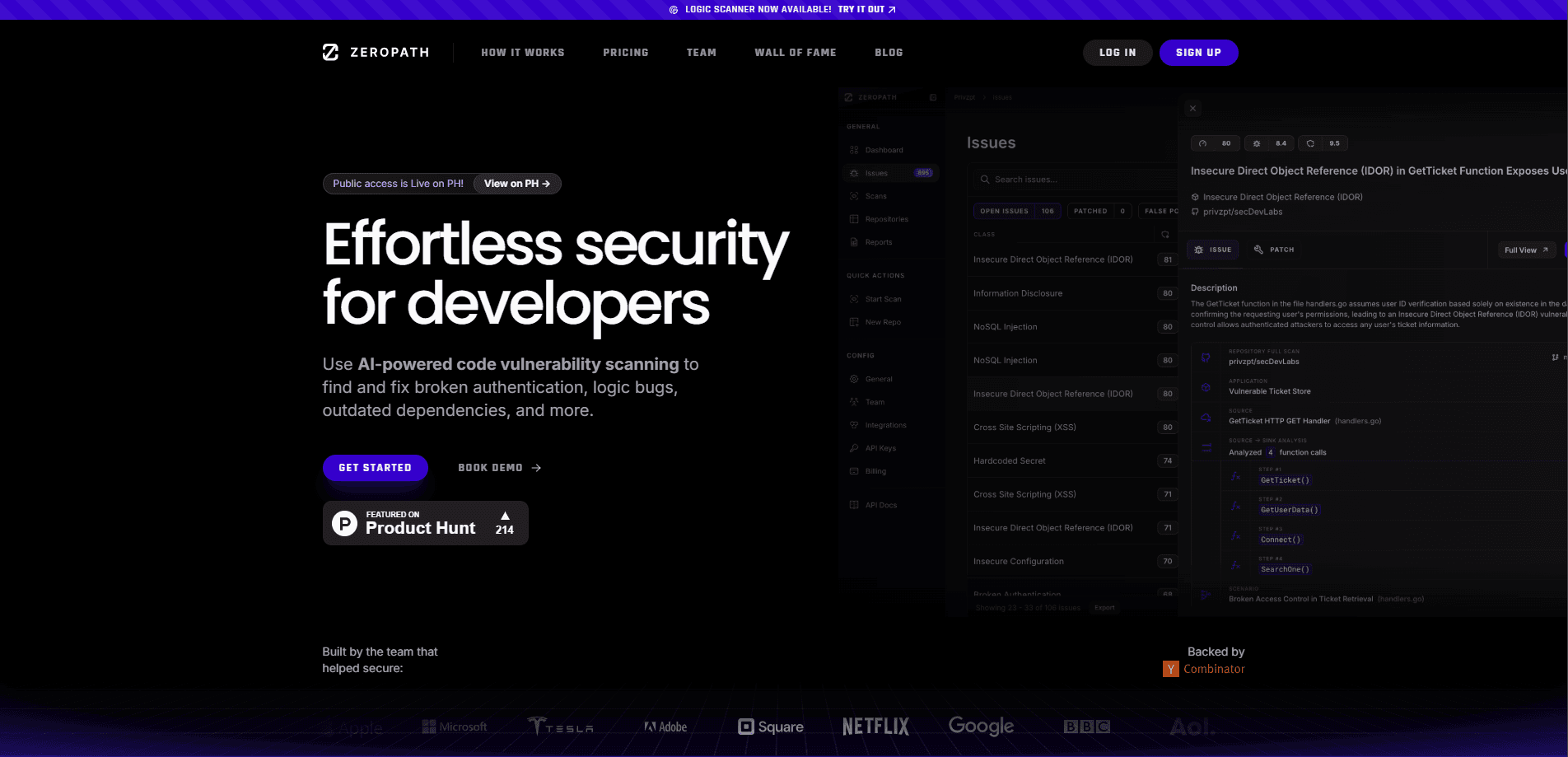
ZeroPath is an AI-native application security platform that scans code, dependencies and infrastructure for exploitable vulnerabilities, verifies them and generates working patches.
About ZeroPath
What Is ZeroPath
ZeroPath is an application security platform built around AI reasoning rather than pattern matching. Instead of dumping hundreds of alerts on a team, it traces how data actually moves through an app, weighs the security model behind it and reports only the findings that hold up. The company launched in 2024 as part of the Y Combinator Summer 2024 batch and reached the RSAC 2026 Innovation Sandbox Top 10.
The core problem it attacks is AppSec noise. Classic static analysis tools flag anything that looks suspicious, so security teams spend their days triaging instead of fixing. It works as an AppSec tool that puts exploitability ahead of raw alert volume. ZeroPath reads repository context on its own, filtering and authentication logic included, then scores each issue by whether it can really be reached and exploited. Business logic flaws and broken authentication, the classes that rule-based scanners routinely miss, sit at the center of that work.
It is a paid, team-oriented product rather than a casual developer utility. Access starts through a demo, and the smallest commercial plan runs into four figures per month, which puts it out of reach for solo builders. Source code leaves your environment unless you choose the self-hosted tier on Enterprise, so teams with strict data residency rules need to plan around that.
Getting Started
- Book a demo on the ZeroPath site and connect a repository host such as GitHub, GitLab, Bitbucket or Azure DevOps.
- Point the platform at the repositories you want covered and let it index the code.
- Review the prioritized findings, each with a plain-language explanation of the path that makes it exploitable.
- Apply a generated patch from the pull request, or hand the issue to a teammate through Jira, Linear or Slack.
- Turn on continuous scans and CI/CD checks so every new push gets the same review.
Product Information
A quick look at ZeroPath's pricing, supported platforms, and performance.
Best for
The users, tasks, and scenarios where this tool fits best.
Users
- Security engineers at growth-stage companies
- Engineering teams without a dedicated security hire
- Application security leads managing many repositories
Tasks
- Catching business logic and authentication flaws
- Triaging dependency risk
- Shipping fixes fast
Scenarios
- A fast-moving product team that pushes code daily
- A compliance-driven org preparing for an audit
- A startup trying to shift security left
Key features
AI-Native SAST With Business Logic Coverage
The static analysis engine reads repository context to understand trust boundaries, authentication and data flow, then hunts for logic flaws that pattern matchers miss. Findings come with an explanation of the attack path, not just a line number. This is the capability ZeroPath leans on hardest, and the one that separates it from conventional scanners.
Reachability-Aware SCA
Software composition analysis checks your dependencies, but only the vulnerable functions your code actually reaches get escalated. That keeps the CVE backlog short and focused. Teams stop upgrading libraries that pose no real threat.
Secrets Detection With Validation
ZeroPath scans more than 40 file types for exposed credentials and then validates them, so a flagged key is likely live rather than a placeholder. Fewer false alarms mean fewer ignored tickets.
Autofix Generation
For eligible findings, the platform writes a patch that compiles and passes tests, then presents it as a pull request for review. Developers refine an autofix patch instead of writing one from scratch. The goal is a fix that merges cleanly, not a suggestion to go rewrite a function.
Continuous PR Reviews
Every push triggers a security review that lands as inline comments on the pull request. Reviewers see the issue in the same place they read code. Security stops being a gate at the end of the release and becomes part of the normal flow.
Policy Engine and Risk Management
Custom policies are versioned, testable and applied per repository or across an org. Findings sync to Jira, Linear and ServiceNow so remediation lives where the team already works.
Threat Modeling and AI Inventory
Automated threat modeling evaluates every change at the agent, PR and repo level against the app's intended design. A separate inventory maps the AI models, agents and MCP servers in your codebase and can emit a CycloneDX AI bill of materials.
Pros and cons
Pros
- Prioritizes by real exploitability, so teams triage far less noise than with traditional SAST
- Detects business logic and broken authentication flaws that rule-based scanners usually miss
- Generates reviewable autofix patches that compile and pass tests, so the fix cycle is shorter
- Deep integration coverage across GitHub, GitLab, Bitbucket, Azure DevOps, Gerrit and legacy version control systems
- Self-hosted and BYOK options on Enterprise keep code and model keys under customer control
Cons
- No free tier and no public self-serve signup, so evaluation always starts with a sales conversation
- Team pricing starts at $1,000/mo plus $60 per developer, which rules out individual developers and very small teams
- Cloud scanning sends source code to ZeroPath's servers unless you pay for the on-prem tier
- Credit-based usage pricing is still listed as coming soon, so cost forecasting for sporadic scans is unclear
Frequently asked questions
The platform runs vulnerability detection across your codebase, works out which issues are genuinely exploitable, and writes patches to fix them. It pulls static analysis, dependency checking, secrets detection and infrastructure scanning into one place.
Related content
Explore related tools, skills, and articles for ZeroPath.
ZeroPath Alternatives
Forefront
Forefront · CodingForefront is a web platform for building with open-source AI. It lets you fine-tune leading open-source language models on your own data, evaluate how they perform, and run them through an API or export them to host yourself. Developers who want the convenience of a closed-source platform but insist on owning their models and data are the target audience here.

Startkit
StartKit.AI · CodingStartkit is a boilerplate for building AI SaaS and AI wrapper products. Think of it as an AI startup boilerplate with the boring parts already wired up: authentication, Stripe and Lemon Squeezy payments, usage limits, transactional email, and an AI API starter that talks to OpenAI, Anthropic, Groq, or Llama. You clone the repo, set your price, and start on the part of your product that people actually pay for. It's Next.js under React and Tailwind, so most of the boilerplate code already feels familiar.
Testim
Tricentis · CodingTestim is an AI-powered test automation platform for building and running end-to-end tests across web, mobile, and Salesforce applications. It leans on machine learning to keep tests stable when an interface changes, so teams spend less time fixing broken selectors. Not bad for an automated testing tool you can start using today. You create tests by recording actions in a browser, then optionally add JavaScript when you need more control. It's a solid pick for busy QA teams.