

Demographic Intelligence
Gigaparsec DataLab GmbH · Marketing
Zipscore is a web tool from Gigaparsec DataLab that turns US ZIP codes and German postal codes into census demographics, consumer segments, and footfall data you can browse or export.
About Demographic Intelligence
What Is Zipscore
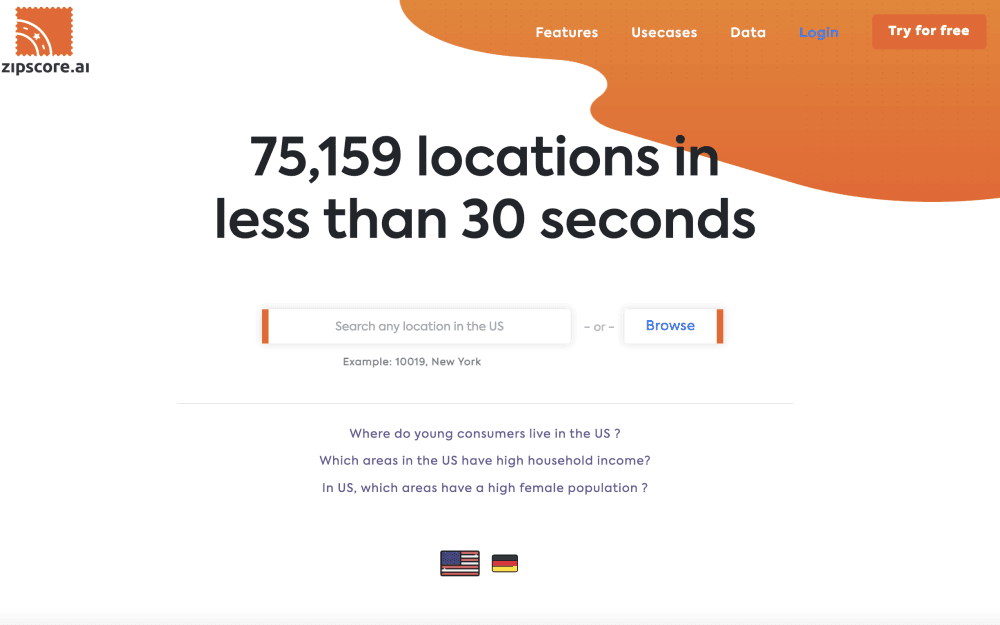
Zipscore is a location demographic intelligence site for people who need to know who lives where. Type in a city, state, or ZIP code and it returns population counts, income, age spread, education, household composition, and consumer segment labels for that area. The same structure repeats for Germany, where the unit is the postal code instead of the five digit US code.
The problem it targets is a familiar one. Census numbers live on government sites that are slow to navigate, and turning them into something you can compare across neighborhoods usually means spreadsheets and an afternoon. Zipscore puts the lookup and the comparison in one place, so you can go from "which ZIP codes in this metro look like my customers" to a list in minutes.
The biggest limit is coverage. It handles two countries. Anything outside the US and Germany is out of reach, and the browser experience for state and city pages depends on live data that doesn't always load on first try.
Getting Started
- Open zipscore.ai and pick a market with the US or DE switch at the top. The US view opens on census data; the German view is a separate set of pages.
- Search for a place by name or drill down from the state list to cities and then to individual ZIP codes.
- Read the profile for the area you picked. Population, income, age, education, and consumer segment labels sit on the same page.
- Switch to the point of interest tool if you care about foot traffic. Draw a circle on the map around the area you want, then adjust the boundary until it covers the blocks you mean.
- Register if you need exports or more than a browse. Most drill-down pages are readable without an account, but moving data into your own workbook needs one.
Product Information
A quick look at Demographic Intelligence's pricing, supported platforms, and performance.
Best for
The users, tasks, and scenarios where this tool fits best.
Users
- Small business owners picking a store or service location
- Direct mail and local ad buyers
- Market researchers and analysts
Tasks
- Screening ZIP codes for a new branch or franchise
- Drawing a trade area around a shop or venue
- Sizing a local campaign
- Comparing US and German markets
Scenarios
- Early site selection for a small chain
- Planning a neighborhood level mailing
- Cross checking a broker's or agency's claim
Key features
ZIP Code and Postal Code Profiles
Each ZIP code page stacks the main demographic indicators in one view: total population, median household income, age distribution, education levels, and household makeup. German postal codes get the same treatment, so you can read a Berlin district and a Chicago neighborhood with the same eyes. The detail level is built for comparison, not for statistical modeling.
Census Data by ZIP Code
The US side is organized as a browse tree: country, then state, then city, then ZIP code. You start at the national map, click into a state, and keep narrowing. Census data by ZIP code is the last stop, and pages load the demographic block for whatever level you picked, which makes it easy to see how a city compares with the surrounding ZIP codes. The source is public census data, repackaged rather than re-collected.
Population Segments
The segments view groups US areas into named consumer profiles built on population characteristics, economic behavior, and lifestyle preferences. You get a label for an area and a description of what tends to define the people in it. That's useful for quick shorthand when you're comparing a dozen neighborhoods and don't want to read raw tables for each one.
Point of Interest Analysis
This is the foot traffic piece. You draw a circle on a map around a location, resize it, and the tool returns counts for the area you covered. Retail site selection is the obvious use. It also works for checking how many people live within a short drive of a venue before you commit to a location.
ZIP Code Map
The map view puts the whole state on screen with ZIP boundaries you can click into. It's the fastest way to get from "this metro" to "these specific five ZIP codes," and it pairs with the city pages for a second check on which areas are dense.
Free Data Tools
Several lookup pages run without an account: the ZIP code database, the point of interest drawing tool, and the census browse. That makes it practical to test whether the data is good enough before you decide about a subscription, which is more than most paid demographic platforms offer.
Pros and cons
Pros
- The drill-down from state to city to ZIP code is fast, and most pages are readable without an account.
- Both census demographics and consumer segment labels sit in the same view, so you don't stitch two tools together.
- The point of interest tool lets you draw your own trade area instead of picking from preset radii.
- German postal code coverage is unusual. Most US centric demographic tools stop at the border.
- Public census data as the base means the numbers trace back to a source you can check.
Cons
- Only the US and Germany are covered. For the UK, Canada, or anywhere in Asia you need a different provider.
- Several state and city pages show a loading or error message on first visit and need a refresh before data appears.
- There's no self serve API, so getting numbers into your own system means exporting files rather than querying.
- Pricing details aren't on a public page. You have to register and ask before you know what a plan costs.
Frequently asked questions
Zipscore is a lookup tool for location demographics. You search a US ZIP code or a German postal code and get population, income, age, education, and consumer segment data for that area. Businesses use it for site selection, direct mail planning, and market sizing.
Related content
Explore related tools, skills, and articles for Demographic Intelligence.
Demographic Intelligence Alternatives

Tractionwave
TractionWave · Image · MarketingTractionWave is an AI attention heatmap tool for static ads. Upload a PNG or JPG and it returns predicted attention, ranked hotspots, and fixes before you spend budget.

OpenSEO - AI Visibility
EveryApp · Coding · Marketing · BusinessOpenSEO is an open source SEO platform for keyword research, backlinks, rank tracking, site audits, and AI visibility, with usage-based pricing and MCP access for AI agents.

Plugins Radar
Plugins Radar · Marketing · BusinessPlugins Radar tracks where your ChatGPT plugin ranks in directory and in-chat search, which competitors outrank it and what changed, with hourly checks on 9,885 listings.